
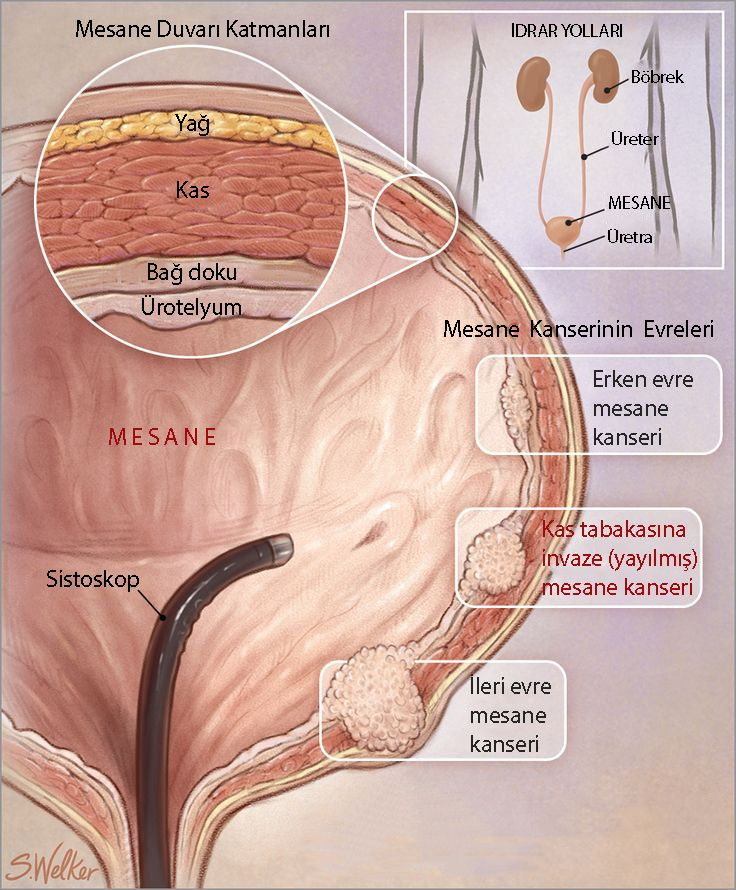
T– Primary Tumour
The suffix (m) should be added to the appropriate T category to indicate multiple tumours. The suffix (is) may be added to any T to indicate presence of associated carcinoma in situ.
TX Primary tumour cannot be assessed
T0 No evidence of primary tumour
Ta Non invasive papillary carcinoma
Tis Carcinoma in situ: ‘flat tumour’
T1 Tumour invades subepithelial connective tissue
T2 Tumour invades muscle
T2a Tumour invades superficial muscle (inner half)
T2b Tumour invades deep muscle (outer half)
T3 Tumour invades perivesical tissue:
T3a microscopically
T3b macroscopically (extravesical mass)
T4 Tumour invades any of the following: prostate stroma, seminal vesicles, uterus, vagina, pelvic wall, abdominal wall
T4a Tumour invades prostate stroma, seminal vesicles, uterus or vagina
T4b Tumour invades pelvic wall or abdominal wall
—————————
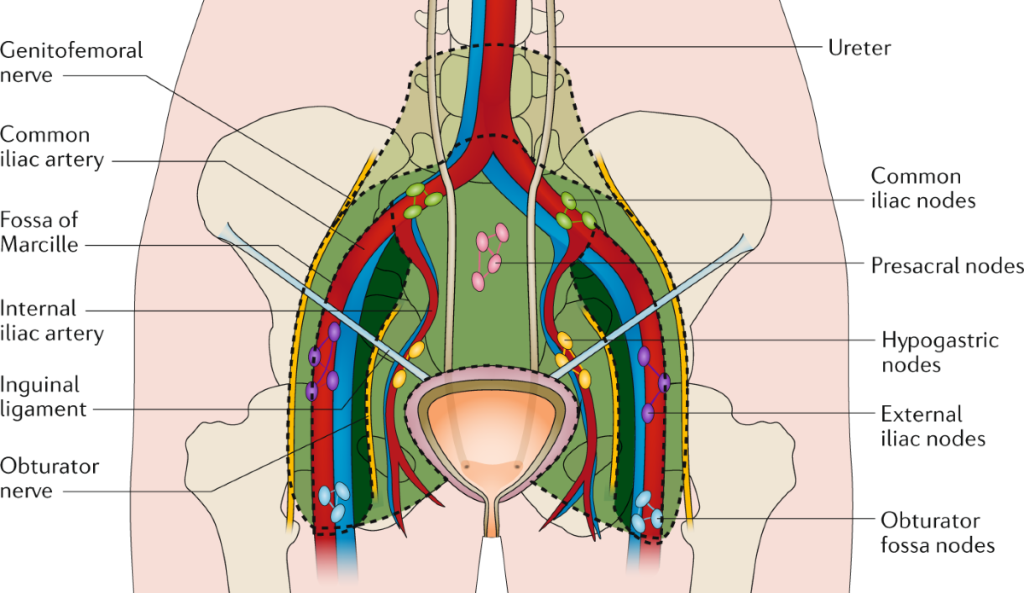
N – Regional Lymph Nodes
NX Regional lymph nodes cannot be assessed
N0 No regional lymph node metastasis
N1 Metastasis in a single lymph node in the true pelvis (hypogastric, obturator, external iliac, or presacral)
N2 Metastasis in multiple regional lymph nodes in the true pelvis (hypogastric, obturator, external iliac, or presacral)
N3 Metastasis in a common iliac lymph node(s)
——————
M – Distant Metastasis
M0 No distant metastasis
M1a Non regional lymph nodes
M1b Other distant metastasis
————–
Stage
Stage 0a Ta N0 M0
Stage 0is Tis N0 M0
Stage I T1 N0 M0
Stage II T2a, T2b N0 M0
Stage IIIA T3a, T3b, T4a N0 M0 yada T1,T2, T3, T4a N1 M0
Stage IIIB; T1, T2, T3, T4a N2, N3 M0
Stage IVA; T4b N0 M0 yada Any T Any N M1a
Stage IVB Any T Any N M1b